
United States, Freedmen's Bureau Marriages, 1859-1873
These records consist of unbound marriage certificates, marriage licenses, monthly reports of marriages and other proofs of marriages. The records are part of the records of the Bureau of Refugees, Freedmen, and Abandoned Lands, part of National Archives Record Group 105 and were compiled from 1861 through 1872. Includes records from the following states: Alabama, Arkansas, Delaware, District of Columbia, Florida, Kentucky, Louisiana, Mississippi, Missouri, South Carolina, Tennessee, and Virginia. NARA publication: M1875: Marriage records of the Office of the Commissioner, Washington Headquarters of the Bureau of Refugees, Freedmen, and Abandoned Lands, 1861-1869 and M1913: Records of the field offices for the state of Virginia, Bureau of Refugees, Freedmen, and Abandoned Lands, 1865-1872 (only marriages).
Start your search
United States Freedmen’s Bureau Marriages
What is in This Collection?
This collection consists of marriage registers and certificates recorded by Bureau Officials for marriages performed by "any ordained minister of the gospel." Most of the marriages recorded are from 1865 and 1868 while others recorded may have taken place prior to the end of slavery.The date given is the original marriage date, while for others the date is the marriage was legalized. Some entries give the names of children born to the couple.
This database combines two record groups created by the Bureau of Refugees, Freedmen, and Abandoned Lands:
- “Marriage Records of the Office of the Commissioner, Washington Headquarters of the Bureau of Refugees, Freedmen, and Abandoned Lands, 1815-1869,” which contains marriage certificates for Louisiana, Mississippi, and Tennessee and some for Alabama (one marriage license), Delaware, Florida, Kentucky, Missouri, South Carolina, and the District of Columbia as well as monthly reports of marriages for Arkansas, Florida, Missouri, Virginia, and the District of Columbia. (National Archives and Records Administration publication number M1875)
- “Records of the field offices for the state of Virginia, Bureau of Refugees, Freedmen, and Abandoned Lands” which includes marriage records from the counties of Augusta, Goochland, Louisa, Nelson and Rockbridge in Virginia. (Only the marriage records from this collection were added to the database.) (National Archives and Records Administration publication number M1913)
Most of the marriages are from the Commissioner's Office and are from NARA microfilm publication M1875, Marriage Records of the Office of the Commissioner, Washington Headquarters of the Bureau of Refugees, Freedmen, and Abandoned Lands, 1861-1869 part of Record Group 105.
Additional marriages are from the field offices of:
- (M1901), Arkadelphia roll 6; Lewisburg roll 7; Fort Smith roll 8; Jacksonport roll 12; Little Rock roll 14; Paraclifta roll 18; Pine Bluff roll 21; Washington roll 23
- District of Columbia (M1902), rolls 12-13
- Kentucky (M1904), Bowling Green roll 92; Mount Sterling roll 125; Owensburg roll 128; Winchester roll 133
- Louisiana (M1905), Mansfield roll 84; Shreveport roll 100
- (M1908), Cape Girardeau roll 24
- Tennessee (M1911), Memphis roll 53
- Virginia (M1913), Goochland roll 89; Lexington roll 101; Louisa roll 104; Lovington roll 105
Additional records and/or images may be added to this collection in the future.
The registration of marriages is based on an order from the Bureau Commissioner from Circular No.5 dated May 30,1865:
"VIII The unity of families, and all the rights of the family relations, will be carefully guarded. In places where the local statutes make no provisions for the marriage of persons of color, the Asst. Commissioners are authorized to designate Officers who shall keep a records of marriages, which may be solemnized by any ordained minister of the gospel, who shall make a return of the same, with such items as may be required for registration at places designated by the Asst. Commissioners. Registrations made by US Officers will be carefully preserved." The circular will be found in NARA microfilm publication M742, roll 7 Selected Series of Records Issued by the Commissioner of the Bureau of Refugees, Freedmen, and Abandoned Lands.
Cohabitation Records
For additional information see the Cohabitation Records article, and the state-specific articles for Alabama, Georgia, Kentucky, Mississippi, North Carolina, Tennessee and Virginia.
Further Reading
- Reginald Washington. Sealing the Sacred Bonds of Holy Matrimony. Freedmen's Bureau Marriage Records Prologue 37(Spring 2005)
- Elaine C. Everly. Marriage Registers of Freedmen. Prologue 5 (Fall 1973)
- Christopher A. Nordmann. Jumping Over the Broomstick: Resources for Documenting Slave Marriages." National Genealogical Society Quarterly 91 (September 2003): 196-216. FS Library 973 B2ng
General Information About Freedmen's Bureau Records
The Bureau of Refugees, Freedmen, and Abandoned Lands was established in the War Department in March of 1865. It was commonly called the Freedman’s Bureau and was responsible for the management and supervision of matters relating to refuges, freedmen, and abandoned lands. The Bureau assisted disenfranchised Americans, primarily African Americans, with temporal, legal and financial matters, with the intent of helping people to become self-sufficient. Matters handled included the distributing of food and clothing; operating temporary medical facilities; acquiring back pay, bounty payments, and pensions; facilitating the creation of schools, including the founding of Howard University; reuniting family members; handling marriages; and providing banking services. Banking services were provided by the establishment of the Freedman’s Saving and Trust Company, or Freedman’s Bank.
The Bureau functioned as an agency of the War Department from approximately June 1865 until December 1868. In 1872, the functions of the Bureau were transferred to the Freedmen’s Branch of the Adjutant General’s Office. The Bureau assisted over one million African Americans, including many of the nearly four million emancipated slaves, which was over 25% of the population of former slaves in America. The records identify those who sought help from the Bureau at the end of the Civil War. Most supplicants were freed slaves, some of which were military veterans. In addition, a few veterans who were not African Americans also sought help from the Bureau. Freedmen’s Bureau records are usually reliable, because the records were supplied through first-person correspondence or the recording of a marriage.
National Museum of African American History & Culture
The museum is working with the Smithsonian Transcription Center and volunteers to transcribe the records of the Bureau.
- Freedmen's Bureau Transcription Project.
- About The Freedmen's Bureau Database Records
- FREEDMEN'S BUREAU ABBREVIATIONS, STAFF ROSTERS, AND STYLE SHEETS
- Freedmen's Bureau - Browse Projects
To Browse This Collection
| You can browse through images in this collection using the waypoints on the Collection Browse Page for United States, Freedmen's Bureau Marriages, 1861-1872. |
What Can These Records Tell Me?
The following information may be found in these records:
- Date marriage was registered
- Name and residence of groom
- Groom's age and color
- Color of groom's parents
- How many years lived with another woman
- Cause of the separation
- Number of children by former companion
- Name and residence of bride
- Bride's age and color
- Color of bride's parents
- How many years lived with another man
- Cause of the separation
- Number of children by former companion
- Number of children with present companion
- Name of officiating minister
- Sometimes, names and ages of children
Collection Content
Sample Images
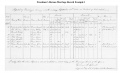
1865 Freedman's Bureau Marriage Record Example 1
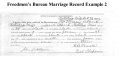
1864 Freedman's Bureau Marriage Record Example 2


Collection Details
Location of Original Records
National Archives and Records Administration
"United States, Freedmen's Bureau Marriages, 1859-1873." Database with images. FamilySearch. http://FamilySearch.org : 6 December 2024. Citing Bureau of Refugees, Freedmen, and Abandoned Lands. National Archives, College Park, Maryland.
